




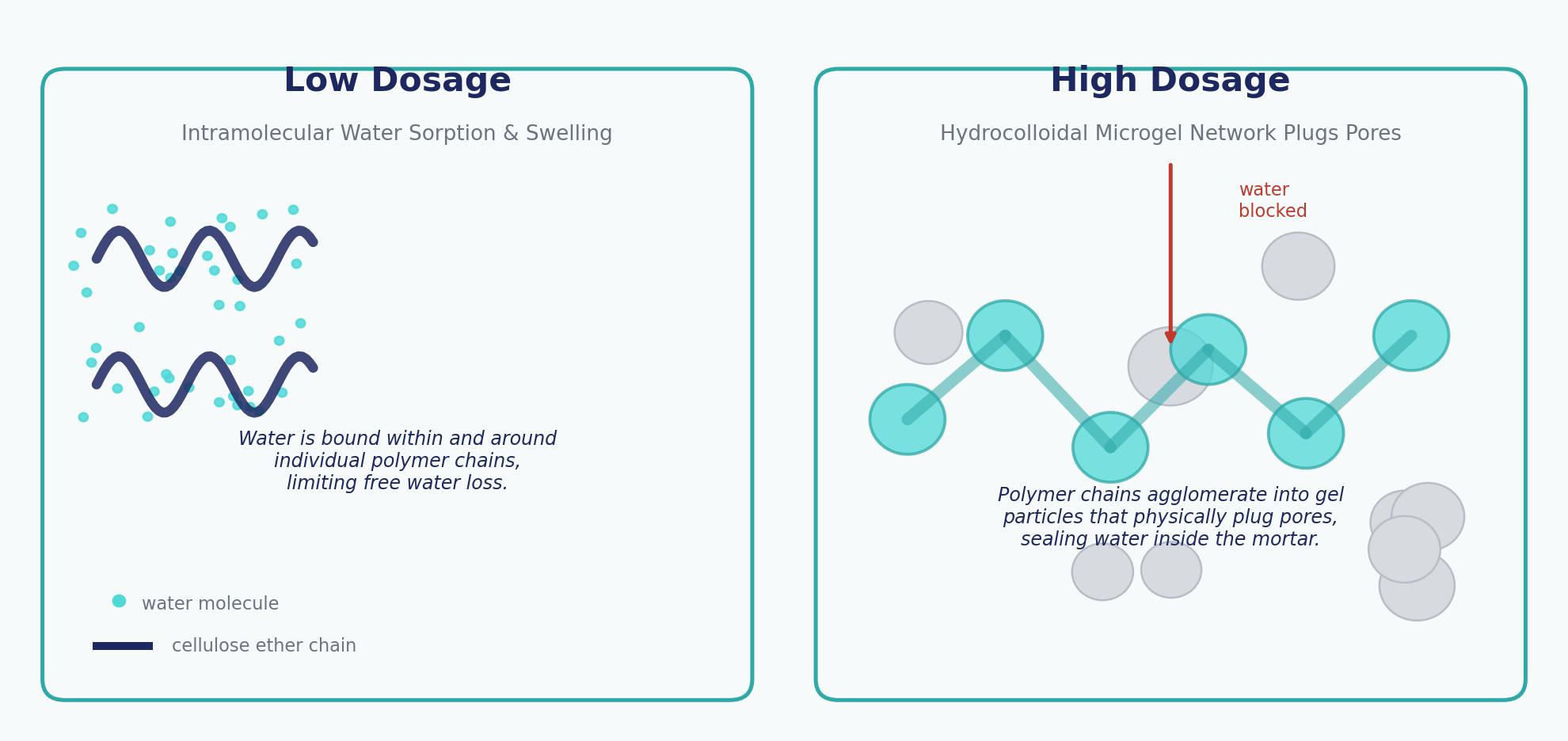
Cellulose ether dosage plays a major role in water retention, but the relationship isn't simply linear. Research into methyl hydroxyethyl cellulose (MHEC) shows two distinct mechanisms depending on dosage level. At low dosages, MHEC retains water primarily through intramolecular water sorption and molecular swelling. As dosage increases, MHEC molecules begin to agglomerate into larger hydrocolloidal microgel particles that physically plug the pore structure of the mortar matrix. This dual mechanism — molecular-level water binding at low concentrations, followed by pore-blocking gel networks at higher concentrations — explains why increasing dosage improves both viscosity and water retention, but with diminishing and eventually non-linear returns.
Particle Size: A Critical, Often Underestimated Variable
Particle fineness is just as important as dosage — arguably more so — because it governs how well the cellulose ether can dissolve and disperse in the first place. Coarse cellulose ether particles dissolve unevenly: their outer surface hydrates first, forming a gel skin that seals the particle and blocks water from penetrating further. In dry-mix mortar applications, where mixing time and shear are limited, this results in unhydrated cores, clumping, and a flocculent or turbid suspension rather than a uniform gel — no amount of extended stirring corrects it once the outer gel layer has formed.
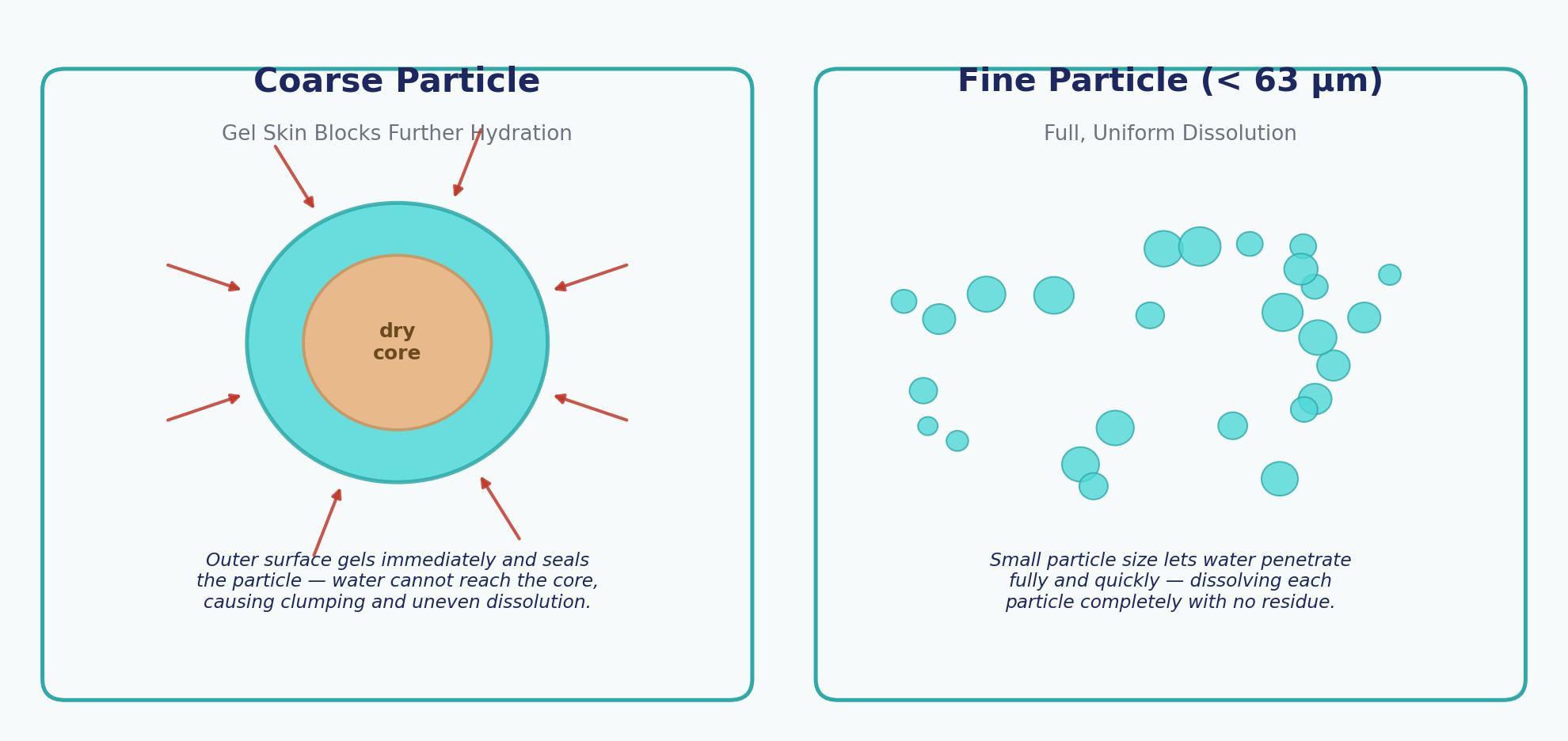
For dry-mix mortars specifically, the cellulose ether should be a fine, low-moisture powder with a particle size distribution where roughly 20%–60% of particles pass below 63 µm. Coarser, more granular cellulose ethers do dissolve in water without necessarily clumping, but their dissolution rate is far too slow for dry-mix mortar processing, where the powder is dispersed among aggregate, filler, and cementitious binder in a single mixing step. Once clumping occurs, uniform redispersion is extremely difficult to recover. The practical consequence isn't just wasted material — unevenly hydrated cellulose ether creates localized weak zones in the mortar, where differential curing rates lead to visible cracking across large-area applications. Machine-sprayed mortars, which allow even less mixing time than hand-applied systems, demand even tighter particle-size control.
Fineness also directly affects water-retention efficiency at a given dosage: comparing two methyl cellulose ethers of identical viscosity, the one with the finer particle size will consistently deliver better water retention at the same dosage level.
The Temperature Problem — and Why It's Still Not Fully Solved
Water retention in methyl cellulose ethers decreases as temperature rises, which is a serious practical concern since dry-mix mortars are frequently applied under high-temperature conditions — exterior wall putty and plastering under direct summer sun on substrate temperatures above 40°C, for example. Heat accelerates cement setting and hardening at exactly the moment water retention is declining, which sharply undermines both workability and crack resistance.
This is a known limitation even in current-generation admixtures. Standard MHEC and methyl hydroxypropyl cellulose (MHPC) — the two most widely used cellulose ethers in dry-mix mortar — perform well under normal conditions but are inherently hydrophobic at elevated temperatures: they either fail to dissolve properly or precipitate out of solution as heat increases, becoming functionally inactive right when they're needed most. Simply increasing the dosage of standard MHEC in summer-grade formulations often fails to fully compensate for this temperature sensitivity.
The more effective solution lies in molecular modification rather than dosage adjustment — specifically, increasing the degree of etherification (substitution) during manufacturing. Higher-substitution cellulose ethers maintain their hydration and gel-forming behavior at elevated temperatures far more reliably than standard grades, preserving water retention, workability, and crack resistance under the harsh, high-temperature conditions where standard products fall short.
Practical Takeaway
Selecting the right cellulose ether for dry-mix mortar isn't a single-variable decision. Dosage, particle fineness, and degree of substitution all interact to determine real-world performance — and for hot-climate or summer-season formulations, the modification chemistry of the cellulose ether matters more than simply adding more of it.
Want to choose a better cellulose ether type for you drymix mortar products, please contact us directly. Our technical team will provide the solutions according to your requirements.
Post time: Sep-11-2026