




Why choose gypsum-based putty?
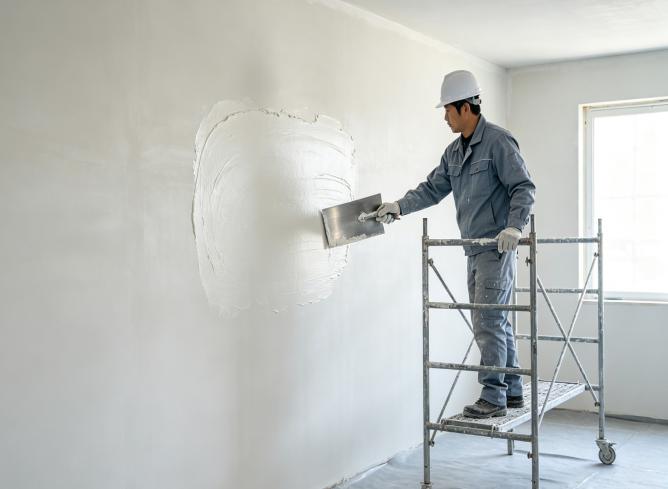
Gypsum putty dries quickly, has a smooth surface, and is not prone to cracking, making it suitable for interior walls. However, it is not water-resistant and cannot be used in bathrooms or on exterior walls.
| Dimension | Gypsum-Based Putty | Cement-Based Putty |
|---|---|---|
| Drying time per coat | 2–4 hours | 12–24 hours |
| Typical whiteness | High, smooth | Lower, greyish |
| Sandability | Excellent | Poor |
| Water resistance | Low (interior only) | Excellent |
| Main use | Interior walls & ceilings, dry areas | Exterior, bathrooms, basements |
Formula Anatomy
The cementing agent is calcined gypsum—usually beta-hydrate calcium sulfate—which reacts with water to enhance coating strength. The classic choice is architectural gypsum, but don't overlook industrial byproducts like phosphogypsum and desulfurized gypsum.
Fillers—heavy calcium carbonate, quartz powder, or talc powder, with a particle size of 200–325 mesh—are responsible for increasing volume, controlling costs, and improving sandability.
In gypsum systems, gypsum itself typically accounts for about 50% of the formulation by weight. For topcoats requiring high whiteness and decorative properties, this proportion can be raised to 80–85%.
Not all plaster putty is the same product. Base coat putty and top coat putty have two different formulas.
Formula 1 is designed to be covered – it's responsible for filling, leveling, and bearing the load.
Formula 2, on the other hand, is applied directly as a decorative finish, so it has a higher gypsum content and doesn't contain any coarse filler. High-whiteness, high-strength gypsum should be used for the finish; how clean the surface is depends on how clean the gypsum itself is.
| Raw Material | Formula 1 (Base Layer) | Formula 2 (Surface Layer) |
|---|---|---|
| Construction gypsum powder | 500 | 650 |
| Heavy calcium carbonate | 450 | 350 |
| RDP / PVA-based organic binder | 20–30 | — |
| Composite retarder | 1.5–3.0 | 2.5–3.0 |
| Sodium dodecylbenzene sulfonate (dispersant) | 25–30 | — |
| Sodium bentonite (thixotropic thickener) | 8–15 | — |
| Hydroxyethyl cellulose (HEC) | 4.5–6.0 | 5.5–6.5 |
Performance-Determining Additives
Alkalinity Regulators and Water-Reducing Agents
Alkalinity regulators are used to adjust the pH value of gypsum grout. Most retarders work best in a weakly alkaline environment, so a small amount of white cement or lime powder is usually added to the formulation for adjustment, which directly affects the setting stability.
Water-reducing agents solve strength problems: the more water added, the lower the strength of the finished product. Adding 0.2%–1.0% of melamine-based or polycarboxylate-based water-reducing agents can reduce water consumption by about 20%–25%, balancing smooth construction and strength.
Cellulose Ethers: Key to Water Retention and Construction
Cracking and powdering are often caused by excessive moisture loss. If moisture evaporates before the gypsum is fully hardened, the surface will become loose and powdery, and the adhesion will decrease.
Cellulose ethers (HPMC, HEC) can retain moisture in the grout and release it slowly, ensuring that the gypsum hardens fully. HEC boasts excellent water retention properties and is a commonly used thickener and water-retaining agent in wall putty.
Selection: Interior wall putty typically uses a viscosity of 75,000–100,000 mPa・s (higher viscosity means thicker and less prone to dripping); for thicker layers and in hot regions, viscosity above 150,000 can be used; low viscosity is used in self-leveling systems. While the cheaper CMC can thicken, it will reduce the surface strength of gypsum in the long run and is not recommended as a substitute for cellulose ethers.
Retarder, Dispersant, and Thickener
Gypsum sets relatively quickly, especially in hot weather. Adding a small amount of compound retarder (citric acid, sodium citrate) can extend the application time without affecting the final strength, but excessive amounts will delay hardening, so the dosage must be controlled.
Dispersants (sodium dodecylbenzenesulfonate, sodium hexametaphosphate) reduce water usage and prevent powder clumping; sodium bentonite improves the thixotropic properties of the slurry (no deformation when stationary, easy flow when scraped); if air bubbles appear during construction, add an appropriate amount of defoamer.
Redispersible Polymer Powder (RDP)
For easily deformable walls, cellulose ether alone is insufficient to prevent cracking; RDP can be added: it can reform a film within the putty, giving the coating flexibility and adhesion strength. Adding approximately 1.5% PVA micro-powder to the base coat achieves good results, while the amount of latex powder used in the top coat is typically no less than 2.0%.
Construction Key Points
Substrate Preparation
Remove dust, oil stains, and loose particles from the wall surface; for porous surfaces (such as newly plastered mortar or plasterboard), apply a primer to seal them. The wall surface moisture content should be controlled below 12%, and newly plastered mortar should be cured for at least 14 days.
Mixing
Add water first, then slowly add powder, stirring at low speed for 3–4 minutes until no lumps remain. Let it stand for about 5 minutes, then stir again. The consistency should be "thick but easy to apply"; in hot weather, stir in small batches multiple times (working time is about 45–60 minutes, shorter as the temperature rises).
Application
The thickness of a single coat should not exceed about 2 mm; excessive thickness can cause cracking. Apply one coat to level the surface, and after it has solidified (plaster takes about 2–4 hours), apply a thin second coat, keeping the edges damp and avoiding seams.
Finishing Steps
Sand smooth with 150-180 grit sandpaper, remove dust, apply primer, and then topcoat. Primer is essential.
Common Problem Troubleshooting
CrackingUsually caused by an overly dry substrate, rapid moisture loss due to lack of primer, or excessively thick coating. The substrate should be treated, and the thickness of each coat should be reduced.
ChalkingUsually caused by insufficient hydration. Improve water retention; apply primer to porous walls first; avoid application in dry, windy environments.
Rapid SettingUsually caused by insufficient dosage or excessively high temperature. Adjust the amount of retarder; in hot seasons, use cellulose ethers with high gel temperature.
Vertical SaggingCaused by excessively low slurry viscosity or insufficient thixotropy. Increase viscosity or add a small amount of bentonite or RDP.
Air Bubbles and PinholesUsually caused by over-mixing, introducing air, or dust on the substrate. Control mixing time, clean the substrate, and add defoamer if necessary.
Choosing the right system, controlling moisture content, and properly preparing the substrate are three key steps to ensure that gypsum-based putty provides a smooth and solid base for the wall, creating favorable conditions for subsequent painting.
Post time: Sep-01-2026