




Plasterboard joint filler (drywall putty) is a core material for high-end wall decoration. It is mainly used to fill the joints between plasterboard panels, level the wall base, and provide a smooth base for finishing processes such as latex paint and artistic paint. Most quality problems such as wall cracking, paint film blistering, peeling, and hollow walls are not due to poor workmanship, but rather to misjudging the dryness time of the putty.
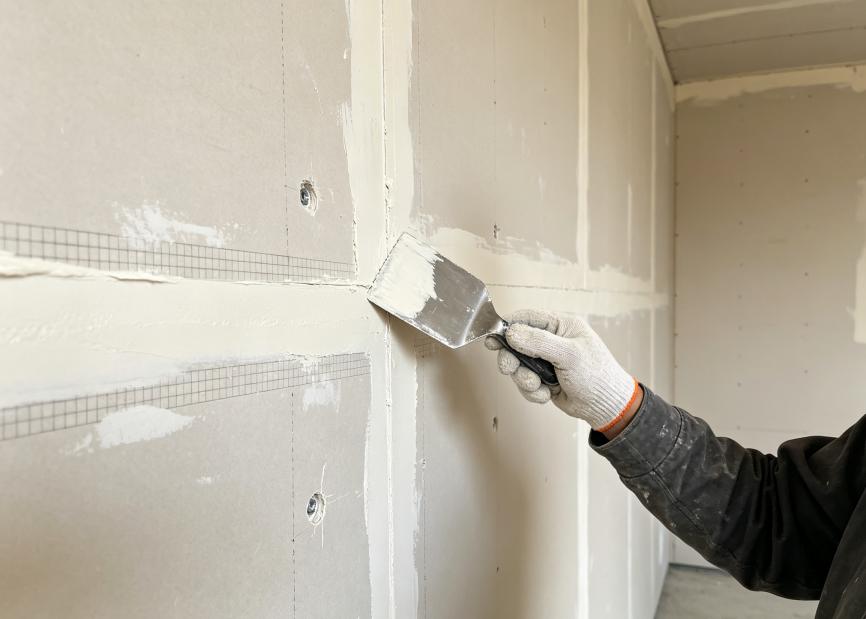
Will putty always harden after drying?
Most mainstream water-based wall joint putty on the market uses calcium carbonate as the main filler and cures through water evaporation. With the help of polymer powder, the powder particles combine to form a dense, hard, and easy-to-sand cured layer, ensuring a smooth and durable wall surface.
However, it’s important to note that not all joint putty hardens after drying. Oil-based sealing putty for industrial pipes is an oil-based system and does not cure through water evaporation, it remains flexible after drying.
Triple Precision Testing Method to Determine if Putty is Completely Dry
Check Appearance and Color
Putty color is highly correlated with internal moisture content:
- • A dark, dull gray overall indicates complete dampness and has not yet begun to harden.
- • A lighter color with uneven distribution and dark spots indicates residual moisture, a high-risk condition for future cracking.
- • A uniform light white or light grayish-white color without any dark spots indicates complete evaporation of moisture, and the putty is completely dry.
Touch Test
Focus on touching the thickest repair and grouting areas:
- • A cool, slightly damp, and slightly sticky feel indicates insufficient internal moisture.
- • A hard surface that leaves an indentation when pressed indicates only the surface is hardened, while the core is damp.
- • Completely dried putty is hard and dry, with the same temperature as the surrounding wall, and leaves no indentation, powder, or adhesive when pressed.
Light Scratching Test
Select a concealed area on the wall and lightly scrape a thick layer of putty with your fingernail or a plastic card:
- • If wet paste or damp residue is scraped off, it indicates that the putty is not completely dry.
- • If only fine, dry powder falls off, it indicates that the putty has reached the standard for sanding and painting.
Standard drying time for different types of joint putty
Under standard construction conditions (temperature 18-24℃, relative humidity 40%-60%, good ventilation):
Gypsum Board Joint Putty
Specifically designed for gypsum board joints, this putty has a low water-retaining agent content, resulting in rapid moisture evaporation, low shrinkage, and uniform curing. For a standard thickness joint layer, complete drying time is 20-22 hours.
General-Purpose All-Purpose Joint Putty
Can be used for filling joints, repairing nail holes, and surface finishing. It has a high powder content, resulting in slightly slower drying. For a standard thickness, complete drying time is approximately 24 hours.
Dust-reducing joint putty
Added water-locking polymer to reduce sanding dust. It dries more slowly, taking 3-5 hours longer than general putty for the same thickness. Thick layers take nearly 30 hours to dry completely.
Construction Interval Specifications
The core principle of multi-layer putty application: Apply the next layer only after the previous one is completely dry. Under standard conditions: 8–12 hours between thin-layer edge putty layers; at least 24 hours between layers of regular thickness joints. Before applying primer or topcoat, the putty must be completely dry, sanded, and all dust removed.
Three Core Factors Affecting Putty Drying Speed
Application Thickness: A single application thickness exceeding 3 mm easily leads to surface skinning and internal water retention. The industry recommends multiple thin applications.
Ambient Temperature and Humidity: Suitable application temperature: 13-35℃. Ambient humidity >70% will significantly delay drying.
Formulation of Building Chemical Additives: MODCELL® Cellulose ethers can regulate water retention, and ADHES® Redispersible polymer powder improves putty strength and crack resistance.
Safe and Accelerated Drying Methods
- Enhance Air Convection: Open windows for ventilation, and use a oscillating fan for gentle airflow.
- Moderately Regulate Room Temperature: Stabilize within the optimal range of 13-35℃.
- Layered Thin-Coat Application: Fill deep pits in 2-3 layers.
- Emergency Use of Quick-Setting Putty: Use water-based quick-setting putty for urgent situations.
The drying time of joint putty is dynamically affected by three factors: construction process, site environment, and additive formulation. Relying solely on product label timing is the primary cause of wall quality defects.
Langou company specializes in the research and development and production of mortar additives. We can provide customized formulation solutions for different scenarios to dry powder mortar manufacturers and construction companies worldwide, helping to improve the quality and efficiency of wall decoration.
Post time: Sep-18-2026